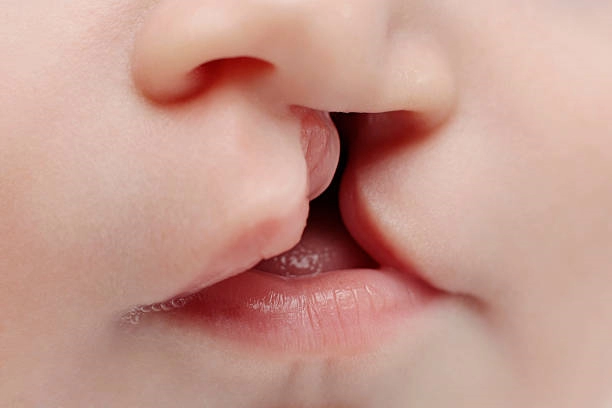
The purpose of cleft lip repair surgery is to close the opening(s) of a cleft lip. This operation usually takes place when a child is ten weeks of age or older, based on the needs of the child and other considerations. Sometimes, we perform this procedure in more than one operation, depending on the width of the cleft and other factors.
WHAT DO WE DO DURING THIS PROCEDURE?
During lip surgery, we cut the tissue near the cleft and rearranges it to close the opening of the cleft and reshape the upper lip (there is no need to take tissue from other parts of the body for this procedure). The newly arranged tissue should enable a child to make an “O” shape with the mouth. The muscles of the upper lip and mouth are important for eating and speech. The drawing to the right shows how the incisions may be planned. After surgery, we may place small tubes called nasal stents into a child’s nostrils to support the nose. The stents are held in place with surgical stitches and will be removed in clinic at a later date, usually weeks or months after the procedure. These tubes help maintain the shape of the nose following the procedure.
WHAT ARE THE RISKS?
Any surgery has risks. The surgeon on the team and the anesthesiologist in the hospital should discuss the risks of surgery with you before the procedure. An anesthesiologist is a doctor who manages pain during a surgical procedure by administering anesthesia. Anesthesia is medicine used during surgery to reduce pain. The anesthesiologist also Figure 1 Example of incisions for lip surgery 5 makes sure that a child is sedated. Sedation is like a deep sleep. During sedation, a person does not feel or remember anything until he or she is brought out of sedation after the surgery. The most common problems that occur with lip surgery are infection and problems with healing. Infection occurs less than 5% of the time. Problems with healing can be caused by bumping or damaging the incision after surgery. While bumps are not common, caregivers need to be as careful as possible to prevent mishaps. It is possible that a child will have problems receiving intubation during surgery (a person receives intubation when undergoing anesthesia. A tube is inserted through the child’s mouth into the windpipe to allow for breathing during surgery). These kinds of problems are rare. If complications occur with intubation, the procedure may take longer than usual, but the delay would rarely cause long-term harm. Very rarely, a person has a reaction or allergy to a drug used for anesthesia. If you know of a family history of adverse reactions to anesthesia, it is important to tell your child’s anesthesiologist.
WHAT IS CLEFT PALATE REPAIR SURGERY?
The purpose of cleft palate surgery is to close the opening in the roof of the mouth. This procedure usually takes place between 6 and 18 months of age. For cleft palate surgery, the surgeon cuts and rearranges tissue around the cleft to close the opening. As with lip surgery, there is usually no need to use tissue from other parts of the body. We may also rearrange the muscles at the back of the mouth, called the soft palate, to support proper speech. In some cases, a we may recommend more than one surgical procedure to close the palate opening completely. This decision depends on many factors such as the width and extent of the cleft. The drawing at left shows the incisions usually made for cleft palate repair.
WHAT HAPPENS AFTER PALATE REPAIR SURGERY? As a child grows, he or she may need additional surgery to improve the function of the palate, especially near the back of the mouth, an important area for speech production. We and speech-language pathologist on the team may recommend one of several procedures to address speech concerns, depending on the needs of the child. The we can lengthen the soft palate, for example, or reduce the opening between the throat and the nose.
Cleft Lip Nose
All complete clefts and many incomplete clefts of the lip involve the nose. The most severe defects are those associated with a bilateral complete cleft, which results in a flattened nasal tip and a shortened columella and sometimes bilateral maxillary hypoplasia and relative prognathism. In children with unilateral cleft lip, nasal deformities are less severe. The nasal alar base on the side of the cleft is laterally displaced, giving the appearance of a flat, horizontal, retracted nostril. The caudal septum also is displaced to the cleft side. The maxilla on the cleft side is hypoplastic, and the nasal tip has a bifid appearance.
Treatment options for nasal deformities associated with cleft lip include both primary and secondary rhinoplasty, which may involve external and/or internal techniques.
Nasoalveolar molding may facilitate primary cleft lip nose repair especially in complete bilateral clefts. Cleft lip nose is corrected typically corrected at two life periods: Preschool or school ages when only the cartilaginous vault of the nose is addressed. We operate preschool kids with severe deformities and wait until nasal vase symmetry is enabled with alveolar cleft repair around 10 years of age. The other age group is postpubertal period when bothe cartilage and bony structures are addressed by using open rhinoplasty technique. We may need to retain some soft material conformers inside the nose to preserve the shape during wound healing.
Velopharyngeal insufficiency (VPI)
VPI is used to describe an anatomical or structural defect that prevents adequate velopharyngeal closure. Velopharyngeal insufficiency is the most common type of VPD because it includes a short or abnormal velum, which occurs in children with a history of cleft palate or submucous cleft.
Velopharyngeal insufficiency treatment usually involves speech therapy and surgery.
Speech therapy can help your child adjust the way they speak to reduce the sounds of VPI. It’s often done before and after surgery.
Surgery aims to create a better seal between the nasal and oral cavities without blocking the airway. The patients with hypernasality (The air escapes to the nose and impairs the quality of speech by causing an unwanted noise and resonance) are usually surgically treated. Surgical approaches depend on the structural problems involved. A surgeon may:
- Change the shape of the soft palate.
- Expand the pharyngeal wall to decrease the distance to the soft palate.
- Lengthen or readjust the palate muscles.
- Take a flap of muscle from the back wall of the throat and attach it to the palate, called a pharyngeal flap procedure.
- Use fat injections or other fillers to help close the palate.
We usually operate for velopaharyngeal insufficiency beginning with preschool ages.
Alveolar Cleft
An alveolar cleft is a cleft of the upper gum line. It most often accompanies and cleft lip and/or cleft palate.
Reasons to repair an alveolar cleft include:
- Allow permanent teeth to descent into the cleft
- Provide stability to the upper jaw
- Provide support to the nose
An alveolar cleft is a gap in the gum line. In a one-sided cleft, there will be one gap in the gum line. In a two-sided cleft, there will be two gaps in the gum line.
Alveolar clefts can have malformed or abnormal teeth growing through or near them.
Around the age of 7, preparations begin for bone grafting of the alveolar cleft. Preparation may include dental x-rays and low radiation CT scans.
When the orthodontist and the surgeon deem the patient ready for a bone graft, usually between the ages of 9 and 11, the bone graft is performed. The operation involves opening up the alveolar cleft, creating a pocket for bone placement, harvesting bone from the hip, and placing the bone in the alveolar cleft. Patients usually stay in the hospital for one night.
Three to six months after bone graft, new x-rays or a low radiation CT scan are obtained in order to check the “take” of the bone graft in the alveolar cleft.
Midface Underdevelopment
Maxillary hypoplasia is a relatively common deformity of cleft lip and palate that can be identified as early as preschool ages. It manifests itself as a concave facial profile and occlusion disorder between upper and lower jaws. Thanks to the distraction osteogenesis, these deformities are now correctable.